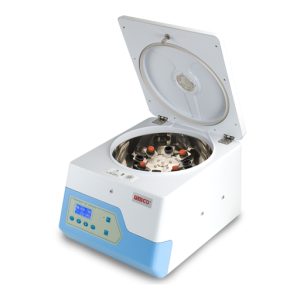




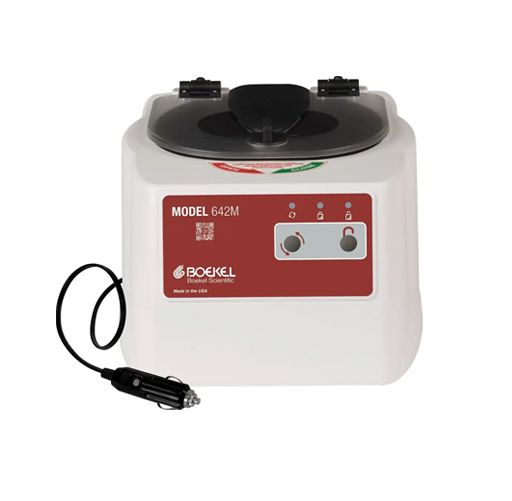
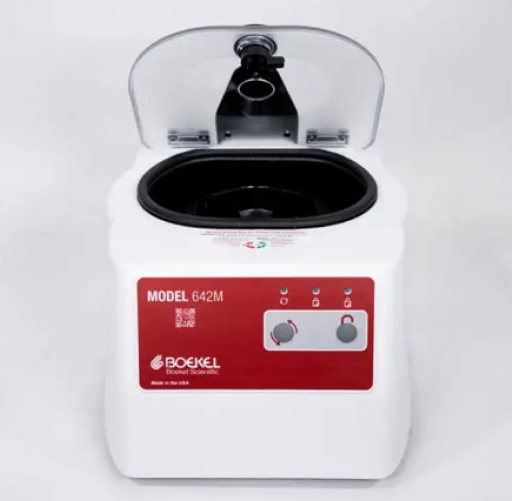
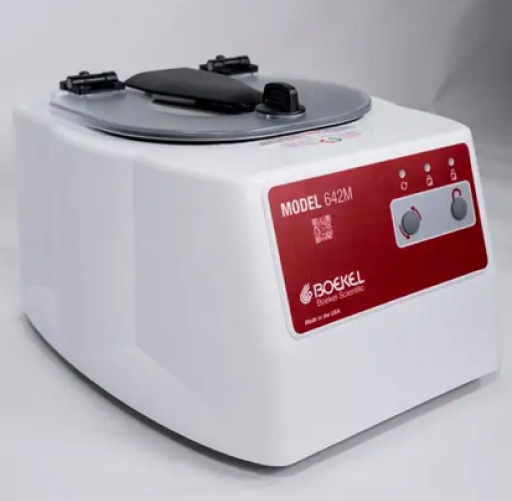
The Boekel-642M Phlebotomy Centrifuge is great for quick and easy spinning of up to 6 collection tubes at any mobile collection site.
Ideal for at-home phlebotomy technicians or a mobile field laboratory. Transportable and comes with an automotive cord for powering. Reliability in specimen testing is necessary for accuracy of clinical results and diagnoses, especially if performed in the field.

Process Samples Directly at the Collection Site
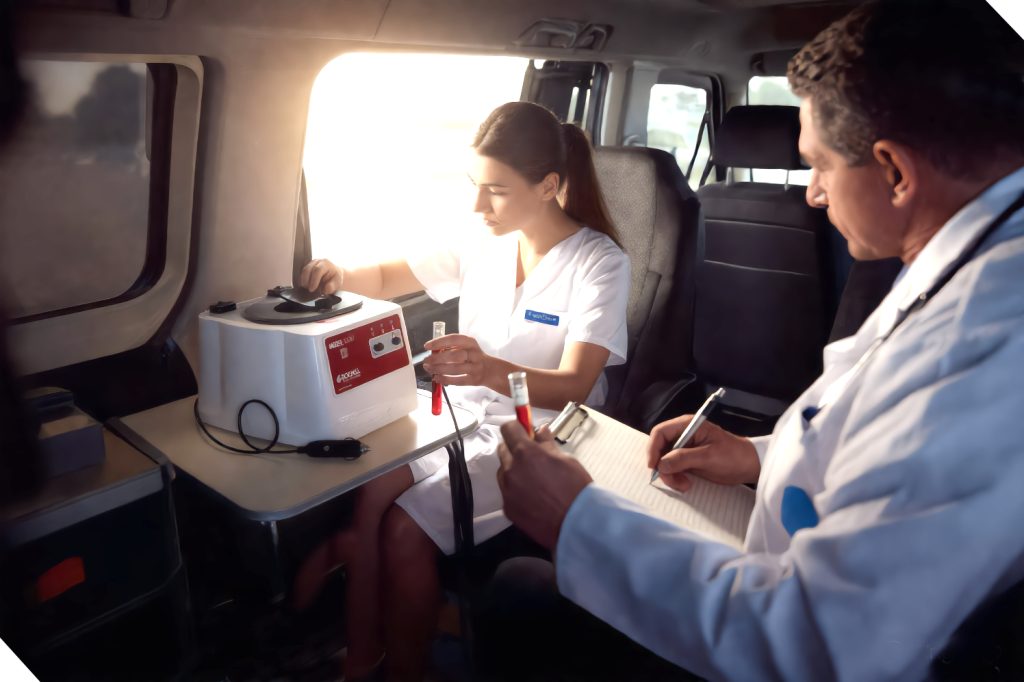
The Boekel 642M mobile centrifuge is designed to process blood collection tubes in a vehicle or at a mobile collection site before transport to the laboratory. Powered directly by a 12 V DC source, it allows mobile phlebotomists, home-care professionals and travelling health services to perform horizontal centrifugation without immediately returning to a fixed facility.
Its six-place horizontal rotor accommodates tubes from 3 to 10 mL, measuring up to 16 × 100 mm. At full speed, the centrifuge reaches 3400 RPM and produces a maximum relative centrifugal force of 1650 × g. The preset cycle helps standardize processing time and centrifugation conditions between collections.
Weighing approximately 5.4 kg and requiring relatively little space, the 642M is well suited to home-care nurses, mobile phlebotomists, travelling clinics, screening programs and services that need to prepare specimens in the field. Its 12 V power system normally eliminates the need for an inverter when used with a compatible vehicle power outlet.
Recommended Applications
The 642M mobile centrifuge is primarily intended for preparing clinical specimens collected outside a conventional laboratory. Typical applications include:
- In-home blood collection.
- Mobile phlebotomy services.
- Home nursing and home-care programs.
- Mobile clinics and travelling health units.
- Community screening programs.
- Specimen collection in long-term care facilities.
- Medical visits in remote locations.
- Occupational health services.
- Field-based clinical research.
- Preparation of compatible serum and plasma tubes.
- Centrifugation of selected microtubes with suitable adapters.
Key Features
- Clinical centrifuge designed for mobile applications.
- Direct 12 V DC operation from a compatible vehicle power source.
- Six-place horizontal swing-out rotor.
- Maximum capacity of six tubes up to 10 mL.
- Compatible with tubes measuring up to 16 × 100 mm.
- Maximum speed of 3400 RPM.
- Maximum relative centrifugal force of 1650 × g.
- Preset 10-minute cycle for more repeatable processing.
- Simple operation that helps reduce variation between users.
- Clear lid for observing the tubes and rotor.
- Automatic lid lock during rotation.
- Relatively quiet operation at approximately 65 dBA.
- Compact format for transport and restricted workspaces.
- Rotor and tube holders supplied with the centrifuge.
- Standard two-year manufacturer warranty.
Technical Specifications
| Manufacturer | Boekel |
|---|---|
| Model | 642M |
| Instrument type | Mobile clinical centrifuge |
| Rotor type | Horizontal swing-out rotor |
| Number of positions | 6 |
| Maximum capacity | 6 tubes up to 10 mL |
| Maximum tube dimensions | Up to 16 × 100 mm |
| Tube compatibility listed on the page | 75 to 100 mm tubes, 3 to 10 mL |
| Maximum speed | 3400 RPM |
| Maximum relative centrifugal force | 1650 × g |
| Preset cycle | 10 minutes at approximately 3400 RPM |
| Power supply | 12 V DC |
| Approximate dimensions | 30 × 35.5 × 22 cm |
| Dimensions in imperial units | 11.75 × 14 × 8.75 in. |
| Weight | Approximately 5.4 kg |
| Sound level | Approximately 65 dBA |
| Refrigeration | No |
| Manufacturer warranty | 2 years |
Horizontal Rotor for Uniform Separation
The swing-out rotor moves the tubes from a vertical position to a nearly horizontal position during rotation. This arrangement promotes the formation of a flat, uniform separation interface, which is particularly useful when processing blood collection tubes containing separator gel.
Consistent separation can make tubes easier to handle after centrifugation and may help reduce the risk of disturbing the barrier formed between specimen components. The selected processing conditions must always follow the tube manufacturer’s instructions, the laboratory procedure and the requirements of the requested test.
Preset Cycle for Greater Repeatability
The 642M operates with a preset 10-minute cycle at a speed of up to approximately 3400 RPM. This configuration simplifies operation and helps reduce variations in run time or speed between different users.
It is particularly useful for mobile services that follow a standardized preparation procedure and do not need to change parameters frequently. Because the preset cycle does not replace the tube manufacturer’s recommendations, the operator must confirm that the speed, relative centrifugal force and processing time are appropriate for the tubes and specimens being handled.
Direct Vehicle Power
The 642M is designed to operate from a 12 V DC vehicle power source. It can therefore be used in a compatible vehicle without a 120 V AC wall outlet and, in most intended configurations, without an AC power inverter.
Before operation, confirm that the vehicle outlet can provide the required current, that the circuit is properly protected and that the connector is firmly seated. The centrifuge must be placed on a stable surface and should not be moved while the rotor is operating.
Designed for Mobile Collection Routes
The ability to centrifuge tubes directly in the vehicle can simplify routes involving several collection appointments. Samples can be prepared closer to the time of collection without requiring the operator to return to the laboratory after each patient.
This approach can help mobile services cover a wider geographical area, reduce unnecessary travel and better control certain pre-analytical steps. On-site centrifugation does not replace requirements governing storage, temperature, processing delays, specimen identification and safe transport.
Lid Safety System
The lid-lock system normally prevents the centrifuge from operating while the lid is open. It also prevents the lid from being opened while the rotor is still moving.
The transparent lid allows the operator to observe the instrument and tubes without interrupting the cycle. Users must never attempt to bypass the safety lock, slow the rotor manually or open the instrument before it has come to a complete stop.
Tube Compatibility
The centrifuge accommodates up to six blood collection tubes measuring up to 16 mm in diameter and 100 mm in length, with a typical maximum capacity of 10 mL per position. It is suitable for several common serum, plasma and whole-blood tube formats.
The manufacturer identifies the following among the tube categories commonly used with this centrifuge:
- EDTA tubes.
- Lithium-heparin or sodium-heparin tubes without gel.
- Serum tubes without gel.
- Serum separator tubes with gel.
- Selected microtubes with separately available adapters.
Compatibility should not be determined by nominal volume alone. Tube length, diameter, bottom shape, cap design and centrifugation requirements must also be verified.
Balancing the Tubes
A centrifuge must always be properly balanced before starting a run. Tubes positioned opposite one another in the rotor should have masses that are as similar as possible. An unbalanced load can cause vibration, reduce separation quality and accelerate wear on the instrument.
- Distribute tubes symmetrically around the rotor.
- Place tubes of similar mass directly opposite one another.
- Use a balance tube containing a suitable liquid when processing an uneven number of specimens.
- Confirm that each tube is fully seated in its holder.
- Do not use cracked, distorted or improperly sealed tubes.
- Stop the run if abnormal vibration occurs.
Recommended Operating Practices
- Place the centrifuge on a firm, level and stable surface.
- Inspect the tubes for cracks, leaks or improperly installed caps.
- Confirm that the tubes are compatible with the holders and preset cycle.
- Load the specimens symmetrically and balance them correctly.
- Close the lid completely before starting the run.
- Begin the cycle according to the operating manual.
- Do not move the instrument while the rotor is turning.
- Wait for the rotor to stop completely and for the lid to unlock.
- Remove the tubes carefully to avoid disturbing the separated layers.
- Store and transport the specimens according to the applicable procedure.
Transporting the Centrifuge
Before moving the instrument, remove all tubes, disconnect the power supply and confirm that the rotor has stopped completely. The centrifuge should remain upright and be protected from impact, drops, excessive moisture and extreme temperatures.
The manufacturer offers a foam transport pad designed to help stabilize the unit in a vehicle. The centrifuge should still be secured so that it cannot slide or become a projectile during sudden braking or evasive manoeuvres.
Cleaning and Maintenance
Regular cleaning helps protect the instrument and reduce the risk of cross-contamination. Before any cleaning or inspection, the centrifuge must be switched off, disconnected and completely stationary.
- Clean spills promptly according to the applicable biosafety procedure.
- Wipe surfaces with a soft cloth and a compatible cleaning product.
- Avoid abrasive cleaners and solvents that may damage plastic components.
- Do not pour liquid directly into the rotor chamber.
- Inspect tube holders regularly for cracks and wear.
- Confirm that the rotor moves freely when stationary and disconnected.
- Inspect the power cord, vehicle plug and electrical connections.
- Do not use the centrifuge if the lid or locking mechanism is damaged.
Blood and other biological material spills must be treated according to the facility’s decontamination procedures. Only products compatible with the centrifuge materials should be used.
Advantages for Mobile Services
- Allows specimens to be processed closer to the collection site.
- Reduces the need for frequent returns to a central laboratory.
- Operates directly from a 12 V vehicle power source.
- Offers a capacity suited to small batches of specimens.
- Standardizes processing with a preset cycle.
- Provides horizontal separation with a swing-out rotor.
- Requires relatively little space in a vehicle or mobile clinic.
- Does not require complicated programming.
- Includes lid safety interlocks.
- Can help improve the organization of mobile collection routes.
Frequently Asked Questions
What is the model number of this mobile centrifuge?
This is the Boekel 642M mobile centrifuge, designed primarily for mobile blood collection, home care and travelling phlebotomy services.
Why use a centrifuge directly at the collection site?
On-site centrifugation allows certain specimens to begin processing without an immediate return to the laboratory. It can simplify routes involving several patients and help organizations comply with specified pre-analytical processing times.
Can the 642M centrifuge operate in a car?
Yes. It is designed to operate from a compatible 12 V DC vehicle power source. The vehicle outlet and circuit must be capable of supplying the required power.
Is a power inverter required?
Normally, a 120 V AC inverter is not required when the centrifuge is connected directly to a compatible 12 V DC vehicle outlet. An unapproved power source should not be used.
Can the centrifuge be operated while the vehicle is moving?
The centrifuge must be used in accordance with the manufacturer’s instructions and remain completely stable. To reduce risks associated with vibration, turning, braking and movement of the instrument, specimens should be processed under stable and safe operating conditions.
How many tubes can it centrifuge at one time?
The horizontal rotor has six positions and can process up to six compatible tubes during one cycle.
What tube sizes are compatible?
The stated maximum capacity is six tubes up to 10 mL and measuring up to 16 × 100 mm. The product page identifies compatible tubes from 3 to 10 mL and 75 to 100 mm in length.
Can it accommodate microtubes?
Selected microtubes up to approximately 2 mL may be used with compatible adapters sold separately. The exact tube format should be confirmed before ordering.
What is the maximum speed?
The centrifuge reaches a maximum speed of 3400 RPM.
What relative centrifugal force does it produce?
The manufacturer lists a maximum relative centrifugal force of 1650 × g. The preset cycle is also commonly described as producing approximately 1600 × g.
What is the difference between RPM and × g?
RPM indicates how quickly the rotor turns. The × g value describes the centrifugal force applied to the specimens and depends on both the rotational speed and rotor radius. Relative centrifugal force is generally more useful than RPM alone when comparing centrifugation protocols.
Is the centrifugation time adjustable?
The 642M is primarily designed around a preset 10-minute cycle to simplify mobile operation and provide repeatable processing. Any available adjustments should be confirmed in the operating manual for the exact version supplied.
What is the advantage of a horizontal rotor?
During rotation, the tube holders swing outward toward a horizontal position. This promotes a flatter and more uniform separation interface, particularly in tubes containing separator gel.
What types of specimens can it process?
It is primarily intended for clinical collection tubes, including selected serum, plasma, EDTA and heparin tubes. Exact use must follow the tube manufacturer’s instructions and the laboratory’s procedures.
Is the centrifuge refrigerated?
No. The 642M is not a refrigerated centrifuge. Specimens requiring precise temperature control must be processed and transported using an appropriate method.
Why must the tubes be balanced?
A balanced load distributes mass evenly around the rotor. An imbalance can create excessive vibration, compromise separation, damage tubes and increase mechanical wear.
Can one tube be centrifuged by itself?
Yes, provided that a balance tube of equivalent mass is placed directly opposite it. A cycle should never be started with an asymmetrical load.
Can the lid be opened during a cycle?
No. The safety system normally prevents the lid from opening while the rotor is turning. The mechanism must never be bypassed.
Is the centrifuge difficult to transport?
No. It weighs approximately 5.4 kg and measures about 30 × 35.5 × 22 cm. Its compact dimensions are intended for vehicles, mobile units and restricted workspaces.
What is its sound level?
The stated sound level is approximately 65 dBA. Unusual noise or vibration may indicate improper balancing, a poorly seated tube or a condition that requires inspection.
How should the centrifuge be cleaned after a spill?
The centrifuge must be disconnected before cleaning. The spill should be treated using a compatible product and according to the facility’s biosafety procedures. Liquids must not enter the electrical or mechanical components.
Does the centrifuge require regular maintenance?
It is designed to require relatively little routine maintenance. The unit should still be cleaned regularly, and the rotor, tube holders, power cable and safety systems should be inspected. Any damage or abnormal operation should be evaluated by a qualified technician.
What is normally included with the centrifuge?
The standard configuration normally includes the centrifuge, a six-place horizontal rotor and tube holders. The inclusion of the vehicle power cable, foam transport pad and other accessories should be confirmed for the exact package being offered.
What is the warranty on the 642M?
Boekel lists a standard two-year warranty. The applicable terms, exclusions and any available extensions should be confirmed at the time of purchase.
Can this centrifuge be used in a fixed laboratory?
It may be useful in selected fixed environments with a compatible power source, but it is primarily intended for mobile collection and small sample batches. Laboratories processing higher volumes may prefer a benchtop centrifuge with greater capacity or adjustable parameters.
How can I confirm whether my tubes are compatible?
Provide the tube manufacturer, catalogue number, volume, diameter, length and tube type. These details allow the physical fit and the compatibility of the preset centrifugation cycle to be evaluated.

The Boekel-642M Phlebotomy Centrifuge is great for quick and easy spinning of up to 6 collection tubes at any mobile collection site.
Ideal for at-home phlebotomy technicians or a mobile field laboratory. Transportable and comes with an automotive cord for powering. Reliability in specimen testing is necessary for accuracy of clinical results and diagnoses, especially if performed in the field.
Process Samples Directly at the Collection Site
The Boekel 642M mobile centrifuge is designed to process blood collection tubes in a vehicle or at a mobile collection site before transport to the laboratory. Powered directly by a 12 V DC source, it allows mobile phlebotomists, home-care professionals and travelling health services to perform horizontal centrifugation without immediately returning to a fixed facility.
Its six-place horizontal rotor accommodates tubes from 3 to 10 mL, measuring up to 16 × 100 mm. At full speed, the centrifuge reaches 3400 RPM and produces a maximum relative centrifugal force of 1650 × g. The preset cycle helps standardize processing time and centrifugation conditions between collections.
Weighing approximately 5.4 kg and requiring relatively little space, the 642M is well suited to home-care nurses, mobile phlebotomists, travelling clinics, screening programs and services that need to prepare specimens in the field. Its 12 V power system normally eliminates the need for an inverter when used with a compatible vehicle power outlet.
Recommended Applications
The 642M mobile centrifuge is primarily intended for preparing clinical specimens collected outside a conventional laboratory. Typical applications include:
- In-home blood collection.
- Mobile phlebotomy services.
- Home nursing and home-care programs.
- Mobile clinics and travelling health units.
- Community screening programs.
- Specimen collection in long-term care facilities.
- Medical visits in remote locations.
- Occupational health services.
- Field-based clinical research.
- Preparation of compatible serum and plasma tubes.
- Centrifugation of selected microtubes with suitable adapters.
Key Features
- Clinical centrifuge designed for mobile applications.
- Direct 12 V DC operation from a compatible vehicle power source.
- Six-place horizontal swing-out rotor.
- Maximum capacity of six tubes up to 10 mL.
- Compatible with tubes measuring up to 16 × 100 mm.
- Maximum speed of 3400 RPM.
- Maximum relative centrifugal force of 1650 × g.
- Preset 10-minute cycle for more repeatable processing.
- Simple operation that helps reduce variation between users.
- Clear lid for observing the tubes and rotor.
- Automatic lid lock during rotation.
- Relatively quiet operation at approximately 65 dBA.
- Compact format for transport and restricted workspaces.
- Rotor and tube holders supplied with the centrifuge.
- Standard two-year manufacturer warranty.
Technical Specifications
| Manufacturer | Boekel |
|---|---|
| Model | 642M |
| Instrument type | Mobile clinical centrifuge |
| Rotor type | Horizontal swing-out rotor |
| Number of positions | 6 |
| Maximum capacity | 6 tubes up to 10 mL |
| Maximum tube dimensions | Up to 16 × 100 mm |
| Tube compatibility listed on the page | 75 to 100 mm tubes, 3 to 10 mL |
| Maximum speed | 3400 RPM |
| Maximum relative centrifugal force | 1650 × g |
| Preset cycle | 10 minutes at approximately 3400 RPM |
| Power supply | 12 V DC |
| Approximate dimensions | 30 × 35.5 × 22 cm |
| Dimensions in imperial units | 11.75 × 14 × 8.75 in. |
| Weight | Approximately 5.4 kg |
| Sound level | Approximately 65 dBA |
| Refrigeration | No |
| Manufacturer warranty | 2 years |
Horizontal Rotor for Uniform Separation
The swing-out rotor moves the tubes from a vertical position to a nearly horizontal position during rotation. This arrangement promotes the formation of a flat, uniform separation interface, which is particularly useful when processing blood collection tubes containing separator gel.
Consistent separation can make tubes easier to handle after centrifugation and may help reduce the risk of disturbing the barrier formed between specimen components. The selected processing conditions must always follow the tube manufacturer’s instructions, the laboratory procedure and the requirements of the requested test.
Preset Cycle for Greater Repeatability
The 642M operates with a preset 10-minute cycle at a speed of up to approximately 3400 RPM. This configuration simplifies operation and helps reduce variations in run time or speed between different users.
It is particularly useful for mobile services that follow a standardized preparation procedure and do not need to change parameters frequently. Because the preset cycle does not replace the tube manufacturer’s recommendations, the operator must confirm that the speed, relative centrifugal force and processing time are appropriate for the tubes and specimens being handled.
Direct Vehicle Power
The 642M is designed to operate from a 12 V DC vehicle power source. It can therefore be used in a compatible vehicle without a 120 V AC wall outlet and, in most intended configurations, without an AC power inverter.
Before operation, confirm that the vehicle outlet can provide the required current, that the circuit is properly protected and that the connector is firmly seated. The centrifuge must be placed on a stable surface and should not be moved while the rotor is operating.
Designed for Mobile Collection Routes
The ability to centrifuge tubes directly in the vehicle can simplify routes involving several collection appointments. Samples can be prepared closer to the time of collection without requiring the operator to return to the laboratory after each patient.
This approach can help mobile services cover a wider geographical area, reduce unnecessary travel and better control certain pre-analytical steps. On-site centrifugation does not replace requirements governing storage, temperature, processing delays, specimen identification and safe transport.
Lid Safety System
The lid-lock system normally prevents the centrifuge from operating while the lid is open. It also prevents the lid from being opened while the rotor is still moving.
The transparent lid allows the operator to observe the instrument and tubes without interrupting the cycle. Users must never attempt to bypass the safety lock, slow the rotor manually or open the instrument before it has come to a complete stop.
Tube Compatibility
The centrifuge accommodates up to six blood collection tubes measuring up to 16 mm in diameter and 100 mm in length, with a typical maximum capacity of 10 mL per position. It is suitable for several common serum, plasma and whole-blood tube formats.
The manufacturer identifies the following among the tube categories commonly used with this centrifuge:
- EDTA tubes.
- Lithium-heparin or sodium-heparin tubes without gel.
- Serum tubes without gel.
- Serum separator tubes with gel.
- Selected microtubes with separately available adapters.
Compatibility should not be determined by nominal volume alone. Tube length, diameter, bottom shape, cap design and centrifugation requirements must also be verified.
Balancing the Tubes
A centrifuge must always be properly balanced before starting a run. Tubes positioned opposite one another in the rotor should have masses that are as similar as possible. An unbalanced load can cause vibration, reduce separation quality and accelerate wear on the instrument.
- Distribute tubes symmetrically around the rotor.
- Place tubes of similar mass directly opposite one another.
- Use a balance tube containing a suitable liquid when processing an uneven number of specimens.
- Confirm that each tube is fully seated in its holder.
- Do not use cracked, distorted or improperly sealed tubes.
- Stop the run if abnormal vibration occurs.
Recommended Operating Practices
- Place the centrifuge on a firm, level and stable surface.
- Inspect the tubes for cracks, leaks or improperly installed caps.
- Confirm that the tubes are compatible with the holders and preset cycle.
- Load the specimens symmetrically and balance them correctly.
- Close the lid completely before starting the run.
- Begin the cycle according to the operating manual.
- Do not move the instrument while the rotor is turning.
- Wait for the rotor to stop completely and for the lid to unlock.
- Remove the tubes carefully to avoid disturbing the separated layers.
- Store and transport the specimens according to the applicable procedure.
Transporting the Centrifuge
Before moving the instrument, remove all tubes, disconnect the power supply and confirm that the rotor has stopped completely. The centrifuge should remain upright and be protected from impact, drops, excessive moisture and extreme temperatures.
The manufacturer offers a foam transport pad designed to help stabilize the unit in a vehicle. The centrifuge should still be secured so that it cannot slide or become a projectile during sudden braking or evasive manoeuvres.
Cleaning and Maintenance
Regular cleaning helps protect the instrument and reduce the risk of cross-contamination. Before any cleaning or inspection, the centrifuge must be switched off, disconnected and completely stationary.
- Clean spills promptly according to the applicable biosafety procedure.
- Wipe surfaces with a soft cloth and a compatible cleaning product.
- Avoid abrasive cleaners and solvents that may damage plastic components.
- Do not pour liquid directly into the rotor chamber.
- Inspect tube holders regularly for cracks and wear.
- Confirm that the rotor moves freely when stationary and disconnected.
- Inspect the power cord, vehicle plug and electrical connections.
- Do not use the centrifuge if the lid or locking mechanism is damaged.
Blood and other biological material spills must be treated according to the facility’s decontamination procedures. Only products compatible with the centrifuge materials should be used.
Advantages for Mobile Services
- Allows specimens to be processed closer to the collection site.
- Reduces the need for frequent returns to a central laboratory.
- Operates directly from a 12 V vehicle power source.
- Offers a capacity suited to small batches of specimens.
- Standardizes processing with a preset cycle.
- Provides horizontal separation with a swing-out rotor.
- Requires relatively little space in a vehicle or mobile clinic.
- Does not require complicated programming.
- Includes lid safety interlocks.
- Can help improve the organization of mobile collection routes.
Frequently Asked Questions
What is the model number of this mobile centrifuge?
This is the Boekel 642M mobile centrifuge, designed primarily for mobile blood collection, home care and travelling phlebotomy services.
Why use a centrifuge directly at the collection site?
On-site centrifugation allows certain specimens to begin processing without an immediate return to the laboratory. It can simplify routes involving several patients and help organizations comply with specified pre-analytical processing times.
Can the 642M centrifuge operate in a car?
Yes. It is designed to operate from a compatible 12 V DC vehicle power source. The vehicle outlet and circuit must be capable of supplying the required power.
Is a power inverter required?
Normally, a 120 V AC inverter is not required when the centrifuge is connected directly to a compatible 12 V DC vehicle outlet. An unapproved power source should not be used.
Can the centrifuge be operated while the vehicle is moving?
The centrifuge must be used in accordance with the manufacturer’s instructions and remain completely stable. To reduce risks associated with vibration, turning, braking and movement of the instrument, specimens should be processed under stable and safe operating conditions.
How many tubes can it centrifuge at one time?
The horizontal rotor has six positions and can process up to six compatible tubes during one cycle.
What tube sizes are compatible?
The stated maximum capacity is six tubes up to 10 mL and measuring up to 16 × 100 mm. The product page identifies compatible tubes from 3 to 10 mL and 75 to 100 mm in length.
Can it accommodate microtubes?
Selected microtubes up to approximately 2 mL may be used with compatible adapters sold separately. The exact tube format should be confirmed before ordering.
What is the maximum speed?
The centrifuge reaches a maximum speed of 3400 RPM.
What relative centrifugal force does it produce?
The manufacturer lists a maximum relative centrifugal force of 1650 × g. The preset cycle is also commonly described as producing approximately 1600 × g.
What is the difference between RPM and × g?
RPM indicates how quickly the rotor turns. The × g value describes the centrifugal force applied to the specimens and depends on both the rotational speed and rotor radius. Relative centrifugal force is generally more useful than RPM alone when comparing centrifugation protocols.
Is the centrifugation time adjustable?
The 642M is primarily designed around a preset 10-minute cycle to simplify mobile operation and provide repeatable processing. Any available adjustments should be confirmed in the operating manual for the exact version supplied.
What is the advantage of a horizontal rotor?
During rotation, the tube holders swing outward toward a horizontal position. This promotes a flatter and more uniform separation interface, particularly in tubes containing separator gel.
What types of specimens can it process?
It is primarily intended for clinical collection tubes, including selected serum, plasma, EDTA and heparin tubes. Exact use must follow the tube manufacturer’s instructions and the laboratory’s procedures.
Is the centrifuge refrigerated?
No. The 642M is not a refrigerated centrifuge. Specimens requiring precise temperature control must be processed and transported using an appropriate method.
Why must the tubes be balanced?
A balanced load distributes mass evenly around the rotor. An imbalance can create excessive vibration, compromise separation, damage tubes and increase mechanical wear.
Can one tube be centrifuged by itself?
Yes, provided that a balance tube of equivalent mass is placed directly opposite it. A cycle should never be started with an asymmetrical load.
Can the lid be opened during a cycle?
No. The safety system normally prevents the lid from opening while the rotor is turning. The mechanism must never be bypassed.
Is the centrifuge difficult to transport?
No. It weighs approximately 5.4 kg and measures about 30 × 35.5 × 22 cm. Its compact dimensions are intended for vehicles, mobile units and restricted workspaces.
What is its sound level?
The stated sound level is approximately 65 dBA. Unusual noise or vibration may indicate improper balancing, a poorly seated tube or a condition that requires inspection.
How should the centrifuge be cleaned after a spill?
The centrifuge must be disconnected before cleaning. The spill should be treated using a compatible product and according to the facility’s biosafety procedures. Liquids must not enter the electrical or mechanical components.
Does the centrifuge require regular maintenance?
It is designed to require relatively little routine maintenance. The unit should still be cleaned regularly, and the rotor, tube holders, power cable and safety systems should be inspected. Any damage or abnormal operation should be evaluated by a qualified technician.
What is normally included with the centrifuge?
The standard configuration normally includes the centrifuge, a six-place horizontal rotor and tube holders. The inclusion of the vehicle power cable, foam transport pad and other accessories should be confirmed for the exact package being offered.
What is the warranty on the 642M?
Boekel lists a standard two-year warranty. The applicable terms, exclusions and any available extensions should be confirmed at the time of purchase.
Can this centrifuge be used in a fixed laboratory?
It may be useful in selected fixed environments with a compatible power source, but it is primarily intended for mobile collection and small sample batches. Laboratories processing higher volumes may prefer a benchtop centrifuge with greater capacity or adjustable parameters.
How can I confirm whether my tubes are compatible?
Provide the tube manufacturer, catalogue number, volume, diameter, length and tube type. These details allow the physical fit and the compatibility of the preset centrifugation cycle to be evaluated.