




Advanced Conductivity, TDS, Resistivity and Salinity Measurement with Laboratory-Grade Data Management
Hanna HI6321 Advanced Conductivity Benchtop Meter
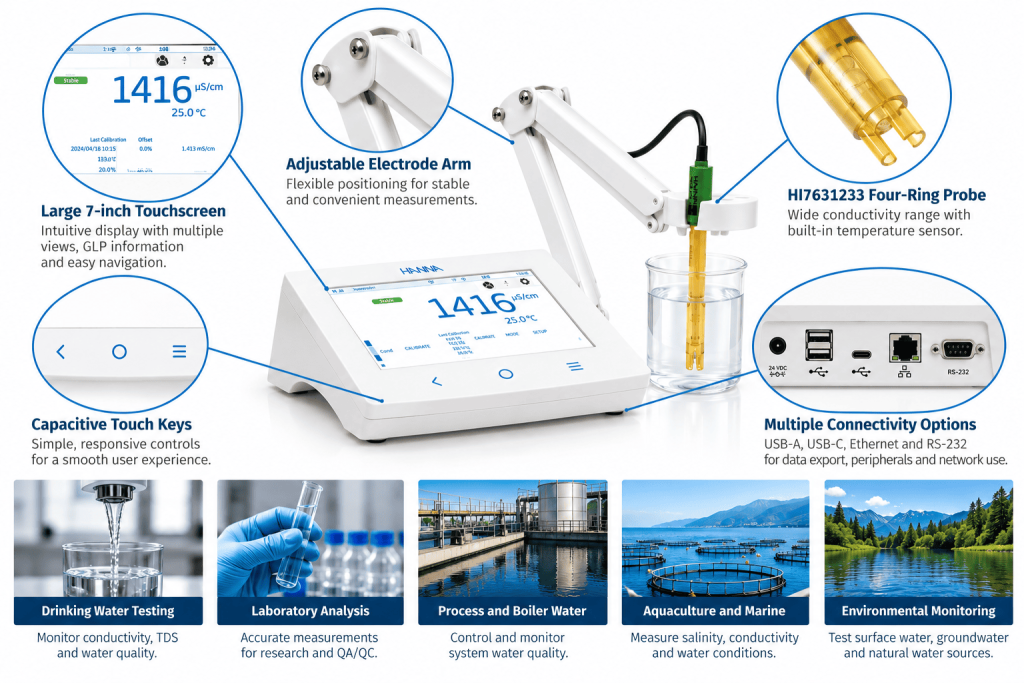
The Hanna Instruments HI6321 Advanced Conductivity Benchtop Meter combines conductivity, resistivity, total dissolved solids (TDS), salinity and temperature measurement in a single laboratory instrument. Its large 7-inch capacitive touchscreen, extensive data logging, application profiles and advanced connectivity make it well suited to routine laboratory testing as well as more demanding water-quality and process-water measurements.
The meter is supplied with Hanna’s HI7631233 four-ring conductivity probe, which provides a very broad measurement range and includes an integrated temperature sensor for automatic temperature compensation.
Wide Conductivity Range from Ultrapure to High-Conductivity Samples
The HI6321 measures conductivity from 0.000 µS/cm up to 1000.0 mS/cm. Its multiple automatically selected ranges allow the same meter to measure very low conductivity water as well as substantially more conductive samples without changing instruments.
Conductivity accuracy is specified at ±1% of the reading or ±0.010 µS/cm, whichever is greater.
Five Parameters from One Probe System
Depending on the selected measurement mode, the HI6321 can display:
- Electrical conductivity (EC)
- Resistivity
- Total Dissolved Solids (TDS)
- Salinity
- Temperature
TDS values are calculated from conductivity using a programmable conversion factor, while salinity can be displayed using Practical Salinity, Natural Seawater or percentage scales.
Four-Ring Conductivity Probe for a Broad Measurement Range
The supplied HI7631233 four-ring platinum conductivity probe is designed for measurements from low to very high conductivity without requiring the frequent probe changes associated with more limited-range conductivity cells.
The probe incorporates its own temperature sensor and has a nominal cell constant of 1 ±15%. Its recommended operating temperature range is -5 to 100°C (23 to 212°F).
Advanced Temperature Compensation
Because conductivity varies with temperature, the HI6321 provides automatic or manual temperature compensation. Several compensation algorithms are available to match different sample types:
- Linear: applies a selectable temperature coefficient for general-purpose conductivity measurements.
- Standard: designed for high-purity water applications and resistivity measurements above approximately 1 MΩ·cm.
- Natural: intended for natural ground, well and surface water or samples of similar composition.
Large 7-Inch Touchscreen with Multiple Data Views
The HI6321 uses a large capacitive touchscreen with intuitive icons and multi-touch support. Users can select the display format that best suits the measurement or documentation requirement.
- Basic View: measurement value, temperature and stability information
- Simple GLP: measurement plus recent calibration information
- Full GLP: detailed calibration-point and probe information
- Graph View: interactive measurement-versus-time graph
- Table View: continuously updated tabulated results
Application Profiles Simplify Repeat Testing
Application-specific profiles allow commonly used measurement settings to be stored and recalled. This reduces setup time when different operators or sample types require established measurement conditions.
The instrument supports up to nine user accounts plus an administrator account, allowing laboratories to separate stored settings and measurement records between users.
Single-Point or Multi-Point Conductivity Calibration
The HI6321 supports automatic recognition of Hanna conductivity standards as well as user-defined standards. Calibration can be performed at a single point or multiple points depending on the required measurement range.
Recognized standard values include:
- 84.00 µS/cm
- 1.413 mS/cm
- 5.000 mS/cm
- 12.88 mS/cm
- 80.00 mS/cm
- 111.8 mS/cm
Calibration reminders can be programmed by time interval to help ensure measurements are performed with a current calibration.
Extensive Data Logging
The meter supports manual, automatic and AutoHold logging. Up to 50,000 records can be stored in an individual file, with storage for at least 1,000,000 data points per user.
Automatic logging intervals can be selected from seconds to several hours, making the HI6321 useful for both individual laboratory measurements and longer-term observation of sample behaviour.
Export and Connectivity Options
Logged data can be exported in CSV format for use in spreadsheets, laboratory records and reporting systems.
- 2 × USB-A ports for USB drives, keyboards or compatible peripherals
- USB-C for PC connection and compatible USB storage
- RS-232 for compatible peripheral devices
- Ethernet network connectivity
- FTP, web-server and email-based data-transfer functions
- Wi-Fi network functions on compatible units and firmware configurations
Key Features
- Conductivity, resistivity, TDS, salinity and temperature measurement
- Conductivity range from 0.000 µS/cm to 1000.0 mS/cm
- ±1% conductivity accuracy
- HI7631233 four-ring conductivity probe included
- Automatic or manual temperature compensation
- Linear, Standard and Natural compensation algorithms
- 7-inch capacitive colour touchscreen
- Five selectable measurement-display formats
- Interactive graph and table views
- Single-point or multi-point conductivity calibration
- Automatic recognition of standard solutions
- Programmable calibration reminders
- Application-specific measurement profiles
- Direct and Direct/AutoHold reading modes
- Selectable Accurate, Medium and Fast stability criteria
- Manual, automatic and AutoHold data logging
- At least 1,000,000 stored data points per user
- CSV data export
- Up to nine user accounts plus administrator
- USB-A, USB-C, RS-232 and Ethernet connectivity
Measurement Specifications
| Parameter | Range | Accuracy |
|---|---|---|
| Conductivity | 0.000 µS/cm to 1000.0 mS/cm | ±1% of reading or ±0.010 µS/cm, whichever is greater |
| Resistivity | 1.0 Ω·cm to 100.0 MΩ·cm | ±1% of reading or ±1 Ω·cm, whichever is greater |
| TDS | 0.000 ppm to 400.0 ppt, depending on range and TDS factor | ±1% of reading or ±0.01 ppm, whichever is greater |
| Salinity – Practical Scale | 0.00 to 42.00 PSU | ±1% of reading |
| Salinity – Natural Seawater | 0.00 to 80.00 ppt | ±1% of reading |
| Salinity – Percent Scale | 0.0 to 400.0% | ±1% of reading |
| Temperature | -20.0 to 120.0°C (-4.0 to 248.0°F) | ±0.2°C / ±0.4°F |
HI7631233 Probe Specifications
| Specification | Value |
|---|---|
| Probe Type | Four-ring conductivity probe |
| Electrode Material | Platinum on glass |
| Measurement Range | 0 to 1000 mS/cm |
| Recommended Operating Temperature | -5 to 100°C (23 to 212°F) |
| Temperature Sensor | Built-in |
| Nominal Cell Constant | 1 ±15% |
| Probe Body | Polyetherimide (PEI) |
| Sensor Body | PVDF |
| Sensor Diameter | 12 mm |
| Connection | DIN |
| Cable Length | 1 m (3.3 ft) |
General Specifications
| Specification | HI6321 |
|---|---|
| Reading Modes | Direct, Direct/AutoHold |
| Sampling Rate | 1000 ms |
| Logging | Manual, Automatic, AutoHold |
| Maximum Records per File | 50,000 |
| Data Storage | At least 1,000,000 data points per user |
| User Accounts | Up to 9 plus administrator |
| USB-A | 2 ports |
| USB-C | 1 port |
| Additional Interfaces | Ethernet and RS-232 |
| Power Supply | 100–240 VAC adapter to 24 VDC, 2.5 A |
| Operating Environment | 0 to 50°C (32 to 122°F), maximum 95% RH non-condensing |
| Dimensions | 205 × 160 × 77 mm (8.0 × 6.2 × 3.0 in) |
| Weight | Approximately 1.2 kg (2.6 lb) |
Standard Scope of Supply
- HI6321 Advanced Conductivity Benchtop Meter
- HI7631233 four-ring conductivity probe
- HI764060 electrode holder with base and mounting hardware
- 1413 µS/cm conductivity standard – 4 sachets
- 5000 µS/cm conductivity standard – 2 sachets
- 12880 µS/cm conductivity standard – 2 sachets
- Electrode rinse solution – 2 sachets
- 24 VDC power adapter
- USB-C to USB-A cable
- Probe quality certificate
- Instrument quality certificate
- Quick reference guide
Q&A
What conductivity range do I need for purified water versus concentrated samples?
Very pure water can have conductivity in the low µS/cm or sub-µS/cm range, while process solutions, brines and concentrated samples can reach many mS/cm. The HI6321’s wide 0.000 µS/cm to 1000 mS/cm range allows the same instrument to cover both low- and high-conductivity applications without changing meters.
When should I use conductivity, resistivity or TDS?
Conductivity is the most direct measurement of a solution’s ability to conduct electrical current. Resistivity is commonly preferred for very pure water because it expresses the inverse of conductivity. TDS is a calculated estimate based on conductivity and a selected conversion factor, so it is most useful when a suitable TDS factor has been established for the sample type.
Why is temperature compensation important in conductivity measurement?
Conductivity changes significantly with temperature, even when the chemical composition of the sample remains unchanged. Temperature compensation converts the measured value to a selected reference temperature so results can be compared more consistently. The HI6321 provides Linear, Standard and Natural compensation modes for different sample types.
Does a four-ring conductivity probe need a cell constant?
Yes. Conductivity measurements depend on the probe’s cell constant. The supplied HI7631233 has a nominal cell constant of 1, and calibration with an appropriate conductivity standard establishes the effective cell constant used by the meter for accurate measurement.
How often should the HI6321 be calibrated?
Calibration frequency depends on the laboratory’s quality requirements, sample type, required accuracy and frequency of use. For demanding work, calibration should normally be checked with a standard close to the expected sample conductivity. The HI6321 allows calibration reminders to be programmed to support a consistent schedule.
Which conductivity standard should I use for calibration?
The best standard is generally one reasonably close to the conductivity range of the samples being measured. The HI6321 automatically recognizes several Hanna standards, including 84 µS/cm, 1.413 mS/cm, 5.000 mS/cm, 12.88 mS/cm, 80.00 mS/cm and 111.8 mS/cm, allowing calibration to be matched to different applications.
Can the HI6321 measure salinity in seawater?
Yes. The meter provides Practical Salinity, Natural Seawater and percentage salinity scales. This makes it suitable for laboratory testing of seawater and other saline samples within the instrument’s specified measurement ranges.
Can different test methods be saved for different sample types?
Yes. Application profiles can store measurement and configuration settings for recurring tests. This is useful when a laboratory routinely switches between applications such as purified water, process water, saline samples or TDS testing and wants operators to recall standardized conditions quickly.
Can the HI6321 automatically record conductivity changes over time?
Yes. Automatic logging can record measurements at selectable time intervals, while graph and table views allow trends to be reviewed directly on the instrument. This is useful for observing sample stabilization, process changes and longer-term conductivity behaviour.
Advanced Conductivity, TDS, Resistivity and Salinity Measurement with Laboratory-Grade Data Management
Hanna HI6321 Advanced Conductivity Benchtop Meter
The Hanna Instruments HI6321 Advanced Conductivity Benchtop Meter combines conductivity, resistivity, total dissolved solids (TDS), salinity and temperature measurement in a single laboratory instrument. Its large 7-inch capacitive touchscreen, extensive data logging, application profiles and advanced connectivity make it well suited to routine laboratory testing as well as more demanding water-quality and process-water measurements.
The meter is supplied with Hanna’s HI7631233 four-ring conductivity probe, which provides a very broad measurement range and includes an integrated temperature sensor for automatic temperature compensation.
Wide Conductivity Range from Ultrapure to High-Conductivity Samples
The HI6321 measures conductivity from 0.000 µS/cm up to 1000.0 mS/cm. Its multiple automatically selected ranges allow the same meter to measure very low conductivity water as well as substantially more conductive samples without changing instruments.
Conductivity accuracy is specified at ±1% of the reading or ±0.010 µS/cm, whichever is greater.
Five Parameters from One Probe System
Depending on the selected measurement mode, the HI6321 can display:
- Electrical conductivity (EC)
- Resistivity
- Total Dissolved Solids (TDS)
- Salinity
- Temperature
TDS values are calculated from conductivity using a programmable conversion factor, while salinity can be displayed using Practical Salinity, Natural Seawater or percentage scales.
Four-Ring Conductivity Probe for a Broad Measurement Range
The supplied HI7631233 four-ring platinum conductivity probe is designed for measurements from low to very high conductivity without requiring the frequent probe changes associated with more limited-range conductivity cells.
The probe incorporates its own temperature sensor and has a nominal cell constant of 1 ±15%. Its recommended operating temperature range is -5 to 100°C (23 to 212°F).
Advanced Temperature Compensation
Because conductivity varies with temperature, the HI6321 provides automatic or manual temperature compensation. Several compensation algorithms are available to match different sample types:
- Linear: applies a selectable temperature coefficient for general-purpose conductivity measurements.
- Standard: designed for high-purity water applications and resistivity measurements above approximately 1 MΩ·cm.
- Natural: intended for natural ground, well and surface water or samples of similar composition.
Large 7-Inch Touchscreen with Multiple Data Views
The HI6321 uses a large capacitive touchscreen with intuitive icons and multi-touch support. Users can select the display format that best suits the measurement or documentation requirement.
- Basic View: measurement value, temperature and stability information
- Simple GLP: measurement plus recent calibration information
- Full GLP: detailed calibration-point and probe information
- Graph View: interactive measurement-versus-time graph
- Table View: continuously updated tabulated results
Application Profiles Simplify Repeat Testing
Application-specific profiles allow commonly used measurement settings to be stored and recalled. This reduces setup time when different operators or sample types require established measurement conditions.
The instrument supports up to nine user accounts plus an administrator account, allowing laboratories to separate stored settings and measurement records between users.
Single-Point or Multi-Point Conductivity Calibration
The HI6321 supports automatic recognition of Hanna conductivity standards as well as user-defined standards. Calibration can be performed at a single point or multiple points depending on the required measurement range.
Recognized standard values include:
- 84.00 µS/cm
- 1.413 mS/cm
- 5.000 mS/cm
- 12.88 mS/cm
- 80.00 mS/cm
- 111.8 mS/cm
Calibration reminders can be programmed by time interval to help ensure measurements are performed with a current calibration.
Extensive Data Logging
The meter supports manual, automatic and AutoHold logging. Up to 50,000 records can be stored in an individual file, with storage for at least 1,000,000 data points per user.
Automatic logging intervals can be selected from seconds to several hours, making the HI6321 useful for both individual laboratory measurements and longer-term observation of sample behaviour.
Export and Connectivity Options
Logged data can be exported in CSV format for use in spreadsheets, laboratory records and reporting systems.
- 2 × USB-A ports for USB drives, keyboards or compatible peripherals
- USB-C for PC connection and compatible USB storage
- RS-232 for compatible peripheral devices
- Ethernet network connectivity
- FTP, web-server and email-based data-transfer functions
- Wi-Fi network functions on compatible units and firmware configurations
Key Features
- Conductivity, resistivity, TDS, salinity and temperature measurement
- Conductivity range from 0.000 µS/cm to 1000.0 mS/cm
- ±1% conductivity accuracy
- HI7631233 four-ring conductivity probe included
- Automatic or manual temperature compensation
- Linear, Standard and Natural compensation algorithms
- 7-inch capacitive colour touchscreen
- Five selectable measurement-display formats
- Interactive graph and table views
- Single-point or multi-point conductivity calibration
- Automatic recognition of standard solutions
- Programmable calibration reminders
- Application-specific measurement profiles
- Direct and Direct/AutoHold reading modes
- Selectable Accurate, Medium and Fast stability criteria
- Manual, automatic and AutoHold data logging
- At least 1,000,000 stored data points per user
- CSV data export
- Up to nine user accounts plus administrator
- USB-A, USB-C, RS-232 and Ethernet connectivity
Measurement Specifications
| Parameter | Range | Accuracy |
|---|---|---|
| Conductivity | 0.000 µS/cm to 1000.0 mS/cm | ±1% of reading or ±0.010 µS/cm, whichever is greater |
| Resistivity | 1.0 Ω·cm to 100.0 MΩ·cm | ±1% of reading or ±1 Ω·cm, whichever is greater |
| TDS | 0.000 ppm to 400.0 ppt, depending on range and TDS factor | ±1% of reading or ±0.01 ppm, whichever is greater |
| Salinity – Practical Scale | 0.00 to 42.00 PSU | ±1% of reading |
| Salinity – Natural Seawater | 0.00 to 80.00 ppt | ±1% of reading |
| Salinity – Percent Scale | 0.0 to 400.0% | ±1% of reading |
| Temperature | -20.0 to 120.0°C (-4.0 to 248.0°F) | ±0.2°C / ±0.4°F |
HI7631233 Probe Specifications
| Specification | Value |
|---|---|
| Probe Type | Four-ring conductivity probe |
| Electrode Material | Platinum on glass |
| Measurement Range | 0 to 1000 mS/cm |
| Recommended Operating Temperature | -5 to 100°C (23 to 212°F) |
| Temperature Sensor | Built-in |
| Nominal Cell Constant | 1 ±15% |
| Probe Body | Polyetherimide (PEI) |
| Sensor Body | PVDF |
| Sensor Diameter | 12 mm |
| Connection | DIN |
| Cable Length | 1 m (3.3 ft) |
General Specifications
| Specification | HI6321 |
|---|---|
| Reading Modes | Direct, Direct/AutoHold |
| Sampling Rate | 1000 ms |
| Logging | Manual, Automatic, AutoHold |
| Maximum Records per File | 50,000 |
| Data Storage | At least 1,000,000 data points per user |
| User Accounts | Up to 9 plus administrator |
| USB-A | 2 ports |
| USB-C | 1 port |
| Additional Interfaces | Ethernet and RS-232 |
| Power Supply | 100–240 VAC adapter to 24 VDC, 2.5 A |
| Operating Environment | 0 to 50°C (32 to 122°F), maximum 95% RH non-condensing |
| Dimensions | 205 × 160 × 77 mm (8.0 × 6.2 × 3.0 in) |
| Weight | Approximately 1.2 kg (2.6 lb) |
Standard Scope of Supply
- HI6321 Advanced Conductivity Benchtop Meter
- HI7631233 four-ring conductivity probe
- HI764060 electrode holder with base and mounting hardware
- 1413 µS/cm conductivity standard – 4 sachets
- 5000 µS/cm conductivity standard – 2 sachets
- 12880 µS/cm conductivity standard – 2 sachets
- Electrode rinse solution – 2 sachets
- 24 VDC power adapter
- USB-C to USB-A cable
- Probe quality certificate
- Instrument quality certificate
- Quick reference guide
Q&A
What conductivity range do I need for purified water versus concentrated samples?
Very pure water can have conductivity in the low µS/cm or sub-µS/cm range, while process solutions, brines and concentrated samples can reach many mS/cm. The HI6321’s wide 0.000 µS/cm to 1000 mS/cm range allows the same instrument to cover both low- and high-conductivity applications without changing meters.
When should I use conductivity, resistivity or TDS?
Conductivity is the most direct measurement of a solution’s ability to conduct electrical current. Resistivity is commonly preferred for very pure water because it expresses the inverse of conductivity. TDS is a calculated estimate based on conductivity and a selected conversion factor, so it is most useful when a suitable TDS factor has been established for the sample type.
Why is temperature compensation important in conductivity measurement?
Conductivity changes significantly with temperature, even when the chemical composition of the sample remains unchanged. Temperature compensation converts the measured value to a selected reference temperature so results can be compared more consistently. The HI6321 provides Linear, Standard and Natural compensation modes for different sample types.
Does a four-ring conductivity probe need a cell constant?
Yes. Conductivity measurements depend on the probe’s cell constant. The supplied HI7631233 has a nominal cell constant of 1, and calibration with an appropriate conductivity standard establishes the effective cell constant used by the meter for accurate measurement.
How often should the HI6321 be calibrated?
Calibration frequency depends on the laboratory’s quality requirements, sample type, required accuracy and frequency of use. For demanding work, calibration should normally be checked with a standard close to the expected sample conductivity. The HI6321 allows calibration reminders to be programmed to support a consistent schedule.
Which conductivity standard should I use for calibration?
The best standard is generally one reasonably close to the conductivity range of the samples being measured. The HI6321 automatically recognizes several Hanna standards, including 84 µS/cm, 1.413 mS/cm, 5.000 mS/cm, 12.88 mS/cm, 80.00 mS/cm and 111.8 mS/cm, allowing calibration to be matched to different applications.
Can the HI6321 measure salinity in seawater?
Yes. The meter provides Practical Salinity, Natural Seawater and percentage salinity scales. This makes it suitable for laboratory testing of seawater and other saline samples within the instrument’s specified measurement ranges.
Can different test methods be saved for different sample types?
Yes. Application profiles can store measurement and configuration settings for recurring tests. This is useful when a laboratory routinely switches between applications such as purified water, process water, saline samples or TDS testing and wants operators to recall standardized conditions quickly.
Can the HI6321 automatically record conductivity changes over time?
Yes. Automatic logging can record measurements at selectable time intervals, while graph and table views allow trends to be reviewed directly on the instrument. This is useful for observing sample stabilization, process changes and longer-term conductivity behaviour.